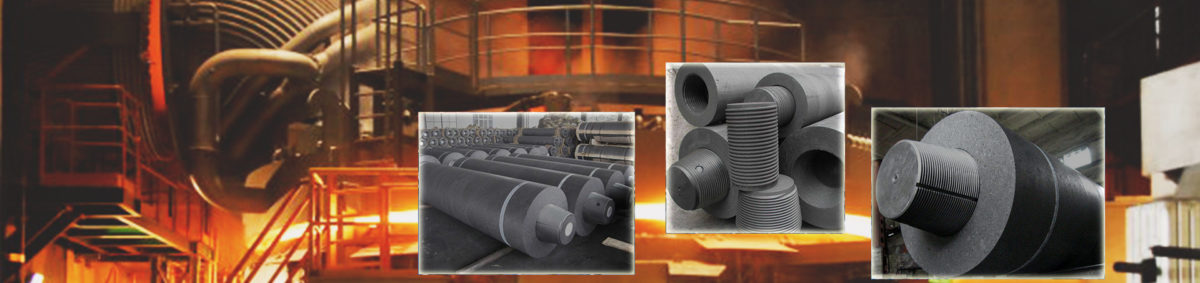
Behind every ton of steel produced in an electric arc furnace lies an invisible engineering triumph: the graphite electrode column. But how does a black, granular petroleum byproduct transform into a silver-gray conductor capable of wielding 50,000 amps at 3000°C? The answer lies in graphite electrode manufacturing—a complex, multi-stage process that few understand and even fewer control.
At Rongsheng Graphite Electrodes Manufacturer, we live this process every day. This article explains the critical role of HP graphite (High Power grade), the application of EAF graphite electrodes in modern melt shops, and the step-by-step reality of graphite electrode manufacturing. Whether you’re a procurement professional, a furnace operator, or an engineering student, understanding these three elements will change how you view electrode performance.
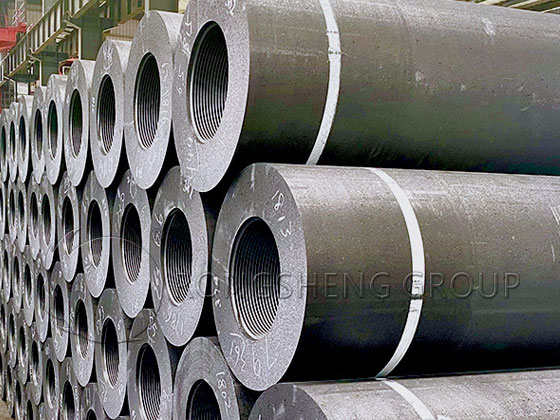
HP Graphite: The Workhorse Grade for Mid-Sized Furnaces
Let’s start with the grade that serves the widest segment of the market: hp graphite. HP stands for High Power, positioned between RP (Regular Power) and UHP (Ultra-High Power) in both performance and cost.
What defines HP graphite?
-
- Electrical resistivity: 6.5–7.5 µΩ·m (compared to 8.0–9.0 for RP, 5.0–5.8 for UHP)
- Flexural strength: 9.5–11.0 MPa
- Bulk density: 1.68–1.72 g/cm³
- Coefficient of thermal expansion (CTE): 2.0–2.5 × 10⁻⁶/K
Where does HP graphite excel?
-
- EAFs with transformer ratings of 15–30 MVA
- Ladle refining furnaces requiring stable arc control
- Stainless steel and specialty alloy production
- Foundries melting 40–80 tons per heat
Why choose HP over other grades? HP graphite offers the optimal balance. It delivers significantly lower consumption than RP (typically 10–15% reduction) without the premium cost of UHP. For the majority of mid-sized melt shops, hp graphite represents the best total cost of ownership.
Rongsheng’s HP grade uses premium needle coke, double impregnation (like UHP), but a slightly shorter graphitization cycle. The result: UHP-like density at HP pricing. Our customers consistently report HP consumption below 1.6 kg per ton of steel—competitive with some UHP products.
EAF Graphite Electrodes: How They Function in the Furnace
Understanding eaf graphite electrodes requires knowing what happens inside the electric arc furnace during a typical melt cycle.
The three-electrode configuration:
Most EAFs use three graphite electrodes arranged in a triangle. Each electrode connects to one phase of the transformer. The arcs jump from electrode tips to the scrap metal, creating temperatures of 3000–4000°C at the arc core.
What the electrode experiences during one heat (45–60 minutes):
-
- Boring stage (first 5–10 minutes) – Electrodes lower into scrap. Arcs penetrate the charge. Maximum mechanical stress from scrap collapse.
- Meltdown stage (next 20–30 minutes) – Arcs fully established. Highest thermal stress. Sidewall oxidation begins.
- Refining stage (final 10–15 minutes) – Arcs stabilize. Temperature holds at 1600–1650°C. Electrode consumption slows.
Why eaf graphite electrodes consume at different rates:
-
- Tip consumption – Caused by arc radiation and chemical reactions with slag. Typically 40–50% of total consumption.
- Sidewall oxidation – Reaction with air and CO₂ above 600°C. Typically 30–40% of total consumption.
- Breakage – Mechanical or thermal shock. Ideally below 5% of total consumption.
Quality graphite electrode manufacturing directly impacts all three consumption mechanisms. Higher density reduces sidewall oxidation. Lower CTE reduces thermal shock breakage. Higher flexural strength reduces mechanical breakage.
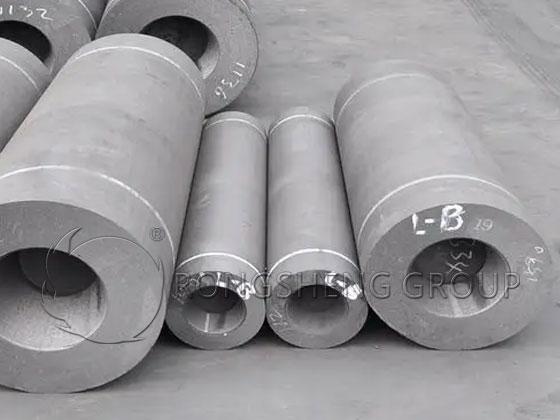
Graphite Electrode Manufacturing: The Six Essential Stages
Now let’s walk through actual graphite electrode manufacturing as practiced at Rongsheng. Each stage builds upon the previous one. Skipping or shortening any stage compromises final performance.
Stage 1: Raw material preparation
Calcined needle coke arrives in different particle sizes (0–0.5mm, 0.5–4mm, 4–8mm). We sieve, crush, and mill to precise specifications. Binder pitch (coal tar pitch) is heated to 150–180°C. The formulation varies by grade—more fine particles for UHP, more coarse for RP.
Stage 2: Mixing and kneading
Needle coke and hot pitch combine in a heated kneader (120–160°C) for 45–60 minutes. The mixture, now called “paste,” must achieve uniform binder distribution. Under-mixing creates weak zones. Over-mixing degrades particle structure.
Stage 3: Forming (extrusion or isostatic pressing)
For diameters up to 700mm, Rongsheng uses vertical extrusion. The paste fills a cylinder, a ram applies pressure (3,000–5,500 tons), and the column extrudes through a die. Green density after forming: 1.72–1.78 g/cm³. Isostatic pressing (used for larger diameters) applies uniform pressure from all directions.
Stage 4: Baking
Green electrodes load into ring furnaces. Temperature rises from ambient to 1200°C over 20–28 days. The ramp rate is critical—too fast creates internal cracks. Baking converts pitch into solid carbon binder (coke). Baked density reaches 1.62–1.68 g/cm³. Porosity: 20–25%.
Stage 5: Impregnation and rebaking
Electrodes go into an autoclave. Vacuum (0.06 MPa absolute) removes air from pores. Hot pitch (200°C) floods the chamber. Pressure forces pitch into pores. Then the electrode rebakes to convert this pitch into carbon. RP grade: one impregnation. HP and UHP: two impregnations. Final bulk density: 1.70–1.76 g/cm³.
Stage 6: Graphitization
The most energy-intensive stage. Electrodes load into Acheson furnaces surrounded by granular coke (resistive medium). Power applies for 15–25 days. Temperature reaches 2800–3000°C. Amorphous carbon transforms into crystalline graphite. Resistivity drops by 40–50%. This stage consumes 3,000–4,000 kWh per ton of electrode.
Stage 7: Machining
Graphitized electrodes move to CNC lathes. We cut:
-
- Socket threads (female) into each end
- Outer diameter to final tolerance (±1.5mm)
- Warning lines (indicating thread depth)
Nipples (male connectors) are machined from the same graphite grade. Thread taper: 1:10 or 1:12, depending on standard (ISO, ASTM, or JIS).
Stage 8: Quality control
Every electrode undergoes:
-
- Ultrasonic testing (internal fissures >1mm flagged)
- Resistivity measurement (four points per electrode)
- Dimensional inspection (length, diameter, thread gauge)
- Visual inspection (surface cracks, chips)
Only after passing all eight stages does an electrode ship from our graphite electrode manufacturing facility.
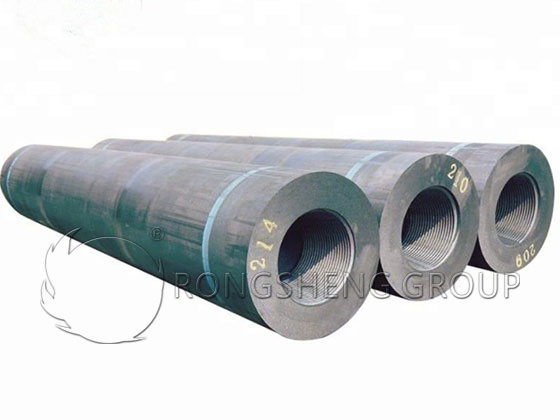
How Manufacturing Quality Affects HP Graphite Performance
Let’s connect graphite electrode manufacturing back to hp graphite performance. Two electrodes with identical specifications can perform differently based on manufacturing consistency:
Example: Resistivity variation
-
- Supplier A (low control): Batch-to-batch resistivity varies 6.5–8.0 µΩ·m (23% range)
- Rongsheng: Batch-to-batch resistivity varies 6.5–7.0 µΩ·m (7% range)
Result: Supplier A’s furnace operators see fluctuating power input. Rongsheng’s customers see stable arcs.
Example: Thread precision
-
- Supplier B (poor machining): Thread taper varies ±0.4mm over 300mm
- Rongsheng: Thread taper varies ±0.1mm over 300mm
Result: Supplier B’s columns loosen after 5–6 heats. Rongsheng’s columns remain tight for 15+ heats.
Why Rongsheng for HP Graphite and EAF Graphite Electrodes?
With decades of graphite electrode manufacturing experience, Rongsheng offers:
-
- Integrated production – All eight stages under one roof. No outsourced steps.
- Grade flexibility – RP, HP, and UHP from the same production lines.
- Diameter range – 300mm to 700mm. HP graphite available in all sizes.
- Technical support – Our engineers analyze your furnace before recommending specifications.
- Lead time – 25 days for custom orders. Stock items ship within 10 days.
The Bottom Line
HP graphite serves the widest segment of EAF steelmakers. EAF graphite electrodes transform electrical energy into melting heat. And graphite electrode manufacturing determines whether that transformation happens efficiently or expensively.
Rongsheng controls all three. We don’t trade electrodes. We manufacture them—from petroleum coke to finished column.
Ready to reduce your HP graphite consumption? Contact Rongsheng today for a free furnace analysis, grade recommendation, and sample batch test records.