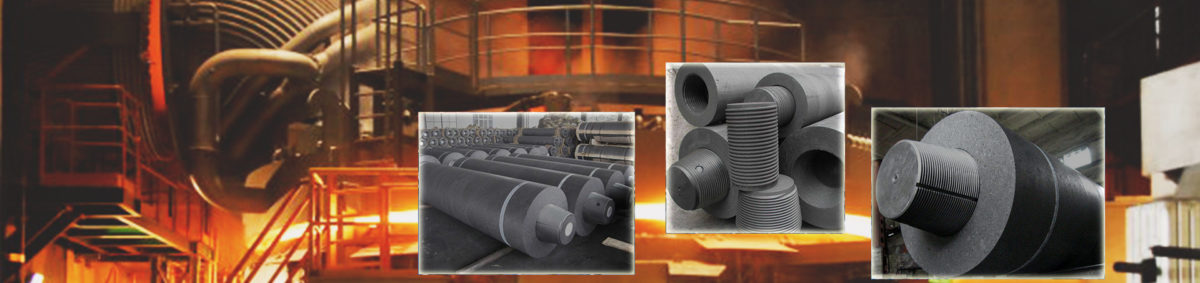
How do Electric Arc Furnace Graphite Electrodes Transform Melt Shops? Without graphite, electric arc furnace steelmaking would simply stop. That statement isn’t hyperbole—it’s physics. Every ton of scrap steel melted in an EAF depends on a controlled electric arc passing through high-density conductive columns. And those columns? They are electric arc furnace graphite electrodes—the only material that can simultaneously conduct thousands of amps, withstand 3000°C+ temperatures, and survive rapid thermal cycling.
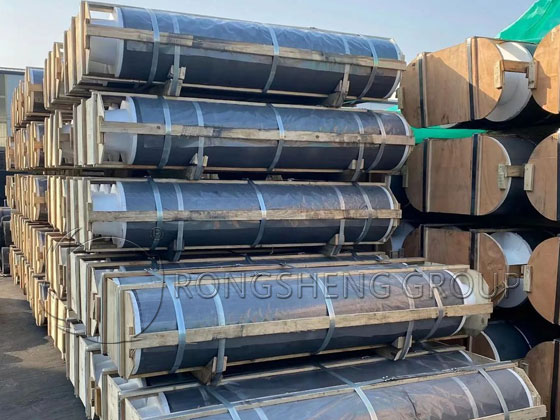
At Rongsheng Graphite Electrodes Manufacturer, we don’t just produce graphite. We engineer electrode graphite specifically for the brutal environment of modern melt shops. This article explains why quality differences in graphite matter, how to match electrode properties to furnace demands, and what separates genuine manufacturing from commodity trading.
The Unique Role of Graphite in Electric Arc Furnaces
Many materials conduct electricity. Few can handle an arc furnace. Copper would melt. Steel would oxidize. Ceramics would crack from thermal shock. Graphite, however, possesses a rare combination of properties:
-
- Sublimation point above 3600°C – It doesn’t melt; it transitions directly from solid to gas.
- Low thermal expansion (CTE ~1.5–4.5 × 10⁻⁶/K) – Minimal dimensional change during rapid heating and cooling.
- High electrical conductivity (resistivity as low as 5.0 µΩ·m for UHP grades) – Efficient power delivery.
- Machinability – Precision threading for column assembly.
But not all electric arc furnace graphite electrodes perform identically. The differences lie in raw material selection, forming methods, and graphitization cycles. A cheap electrode might work for a few heats. A properly manufactured one lasts through hundreds.
Electrode Graphite Grades: Matching Performance to Furnace Power
The term electrode graphite covers a spectrum of grades. Choosing the wrong grade for your furnace transformer is like putting diesel in a gasoline engine—it will work briefly, then fail expensively.
Ultra-High Power (UHP) Graphite:
-
- Resistivity: ≤ 5.8 µΩ·m
- Flexural strength: ≥ 10.5 MPa
- CTE: ≤ 1.5 × 10⁻⁶/K
- Application: Large EAFs (>100 tons) with transformer ratings >30 MVA, ultra-high-power ladle furnaces
High Power (HP) Graphite:
-
- Resistivity: 6.5–7.5 µΩ·m
- Flexural strength: ≥ 9.5 MPa
- CTE: 2.0–2.5 × 10⁻⁶/K
- Application: Mid-sized EAFs (40–100 tons), standard ladle refining furnaces
Regular Power (RP) Graphite:
-
- Resistivity: 8.0–9.0 µΩ·m
- Application: Small EAFs (<40 tons), submerged arc furnaces for ferroalloys
Rongsheng produces all three grades. Our recommendation always starts with your transformer capacity, scrap quality, and target tap-to-tap time. Over-specifying wastes money. Under-specifying destroys electrodes.
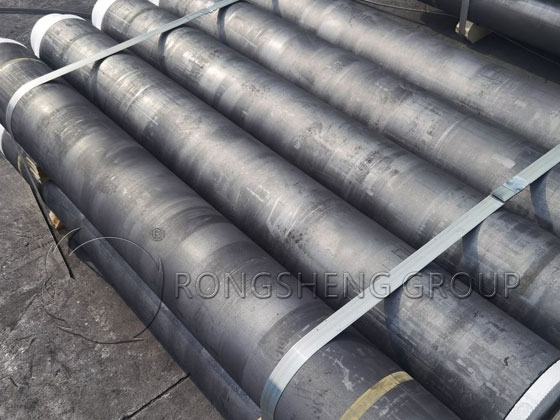
What Happens Inside an Electric Arc Furnace During Melting?
To understand why electric arc furnace graphite electrodes fail, you must understand the environment they operate in. During a typical melt cycle (45–60 minutes), each electrode experiences:
-
- Startup thermal shock – Room temperature to 2500°C arc tip in under 60 seconds.
- Mechanical vibration – Scrap collapse causes sudden column impacts.
- Oxidation – Air infiltration burns sidewalls at rates up to 15% per hour above 600°C.
- Thermal cycling – Multiple heating/cooling cycles per day (often 3–5 heats per electrode set).
Failure modes directly trace to manufacturing quality:
-
- Longitudinal cracking → Poor needle coke quality or rushed graphitization.
- Nipple breakage → Incorrect thread geometry or mismatched thermal expansion.
- Excessive sidewall consumption → Low bulk density or inadequate anti-oxidation treatment.
Quality electrode graphite resists all four stressors. Generic graphite fails at least one.
Rongsheng’s Manufacturing Process for Electrode Graphite
We control every stage of production. That’s the only way to guarantee consistency in electric arc furnace graphite electrodes.
Raw Material Selection: Only calcined needle coke from certified sources. For UHP grade, we use premium coke with specific crystallite orientation (Lc > 30 nm, d002 < 0.337 nm). Impurities (ash content) kept below 0.3%.
Forming: Isostatic pressing for diameters above 500mm; vibration forming for 300–500mm. Pressure exceeds 15,000 psi to eliminate internal voids. Green density minimum 1.75 g/cm³.
Baking: 28-day cycle in oxygen-free ring furnaces. Temperature rises from ambient to 1200°C at precisely controlled rates. Baked density reaches 1.62–1.68 g/cm³.
Impregnation: Pitch impregnation under vacuum (0.06 MPa absolute pressure) fills remaining porosity. UHP grades receive two impregnation cycles. Resulting bulk density: 1.72–1.76 g/cm³.
Graphitization: Acheson furnace treatment at 2800–3000°C for 15–25 days. This converts amorphous carbon into crystalline graphite. Resistivity drops by 40–50% during this stage.
Machining: CNC lathes cut threads to ISO 7811 standards. Thread taper tolerance: ±0.1mm over 300mm length. Each nipple is match-marked to its electrode.
Quality Verification: Ultrasonic testing (100% of production) detects internal fissures >1mm. Electrical resistivity measured at four points per electrode. Flexural strength tested on sample bars from each batch.
Common Misconceptions About Electric Arc Furnace Graphite Electrodes
Myth 1: All electrode graphite is basically the same.
False. Resistivity can vary by 200% between RP and UHP grades. CTE varies by 300%. These aren’t minor differences—they determine whether your electrode column survives a power surge.
Myth 2: Larger diameter always means better performance.
Not necessarily. Diameter must match transformer capacity. A 500mm electrode on a 20 MVA furnace will underperform because current density is too low to maintain arc stability.
Myth 3: Anti-oxidation coating is optional.
No. Above 600°C, uncured graphite oxidizes at 0.5–1.5 mm per hour. A 450mm electrode loses 10mm of diameter after 10 hours without coating. That’s a 20% cross-section reduction.
Myth 4: Cheaper electrodes save money.
Rarely. Low-cost electric arc furnace graphite electrodes typically show 15–25% higher specific consumption (kg per ton of steel). They also break more frequently, causing unplanned downtime. The total cost of ownership almost always favors quality.
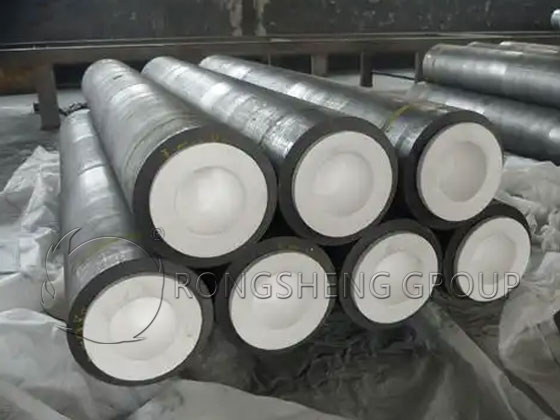
Real Results from Rongsheng’s Electrode Graphite
An EAF operator processing 120 tons per heat switched from a low-cost supplier to Rongsheng UHP grade Electrode. Results over six months:
-
- Electrode consumption: 1.95 kg/t → 1.52 kg/t (22% reduction)
- Breakage incidents: 9 per quarter → 2 per quarter
- Power-on time: reduced by 7 minutes per heat
Another customer—a stainless steel mill using HP grade—reported 11% lower nipple-related failures after switching to Rongsheng’s precision-machined threads.
These improvements don’t require furnace modifications. They only require better electrode graphite.
Why Rongsheng?
We are not traders. We are not resellers. Rongsheng is a full-process manufacturer of electric arc furnace graphite electrodes with:
-
- Annual production capacity: 60,000 metric tons
- ISO 9001:2015 certified quality system
- In-house needle coke storage (3-month buffer inventory)
- Technical team available for on-site furnace analysis
- Typical lead time: 25 days for custom orders; 10 days for standard diameters
We don’t promise the lowest price. We promise the lowest total cost per ton of steel produced.
Rongsheng Electric Arc Furnace Graphite Electrodes for Sale
Your electric arc furnace is a precision tool. It deserves electric arc furnace graphite electrodes that match its capabilities. Generic graphite introduces variables you don’t need—variable consumption, variable breakage, variable power input. Rongsheng eliminates those variables through controlled manufacturing from coke to the finished column.
Stop guessing with generic electrode graphite. Contact Rongsheng today for a furnace-specific electrode recommendation and a side-by-side consumption comparison.